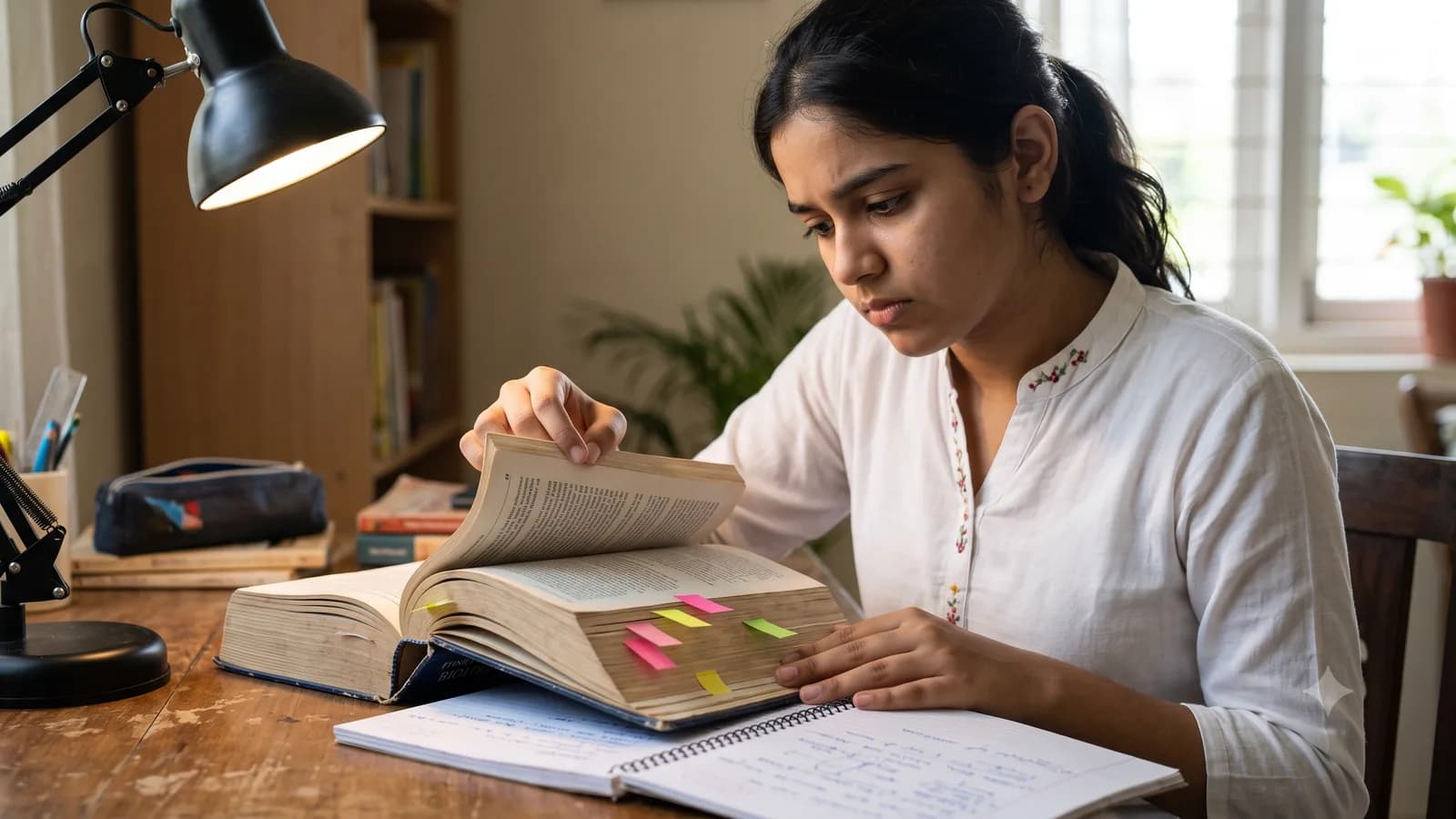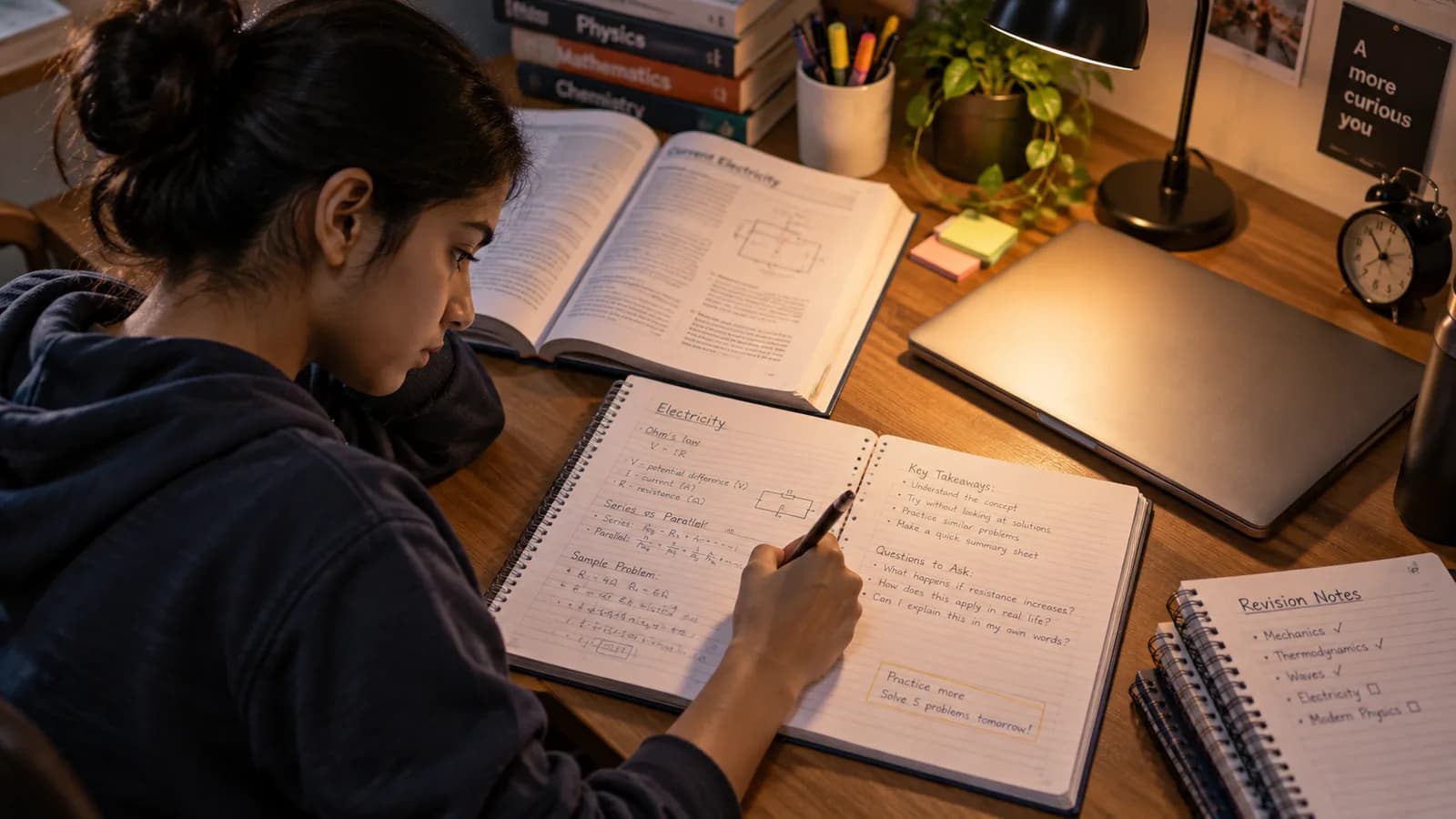
A student who revises history by reading their notes twice will usually do reasonably well. A student who revises maths the same way will usually be surprised by their mark, and will not understand why, because the method worked everywhere else.
It is not a discipline problem and it is not an intelligence problem. It is a mismatch between the subject and the method. Maths does not behave like the subjects around it on the timetable, and studying it as though it does is the single most common reason capable students underperform in it.
Why reading maths notes does almost nothing
Open a maths exercise book at a solved problem and read it. Every line follows from the one above. Nothing is confusing. You will finish with a strong sense that you understand the topic.
That sense is the problem. Psychologists call the effect fluency: when something is easy to process, we read that ease as evidence that we know it. A worked solution is maximally easy to process, because every difficult decision has already been made for you and removed from the page. What you are experiencing is not understanding. It is the absence of difficulty, which is a completely different thing.
The test of whether you can do a maths problem is whether you can produce the next line when nobody has written it for you. Reading never asks you to do that, so it never tests the thing it feels like it is testing.
Here is the check, and it takes ninety seconds. Take a problem you read and understood yesterday. Cover the solution. Do it. Most students who try this for the first time are unpleasantly surprised, and the surprise is the useful part -- it is much better to have it now than in an exam hall.
Procedural subjects and content subjects
It helps to divide school subjects into two rough groups.
Content subjects -- history, biology, geography, most of literature -- are largely about knowing things. The bottleneck is retrieval: can you get the fact, the date, the definition, the quotation out of your head when asked. Methods that strengthen retrieval work well here.
Procedural subjects -- maths, physics, chemistry calculations, programming -- are largely about doing things. Knowing the quadratic formula is worth very little; the skill is recognising that this particular messy question is a quadratic in disguise, then executing it without arithmetic slips under time pressure. The bottleneck is not retrieval. It is decision-making and execution.
You cannot practise decision-making by reading someone else's decisions, any more than you can learn to drive by watching. This is the whole of it. Almost every specific piece of advice below follows from this one distinction.
Note that the split is not clean. Maths has content -- definitions, formulae, standard results -- and that content does need to be retrievable. But it is the smaller half, and it is the half most students over-invest in because it is the half that feels like studying.
The re-do rule
One rule, and it changes more than anything else on this page.
A problem you got wrong is not finished when you understand the correction. It is finished when you can do it again, unaided, on a different day.
What most students do: get it wrong, look at the solution, think ah, I see, move on. What has been learned there is that the solution makes sense. That is not the same as being able to generate it, and the gap between the two is exactly where exam marks are lost.
What to do instead:
- Attempt the problem properly. Struggle for a few minutes before looking anything up -- the struggle is not wasted time, it is what makes the eventual explanation stick.
- If you are stuck, look at the solution, but only until you see the step you were missing. Then cover it again and continue on your own.
- Mark the question. A star, a dot, anything.
- Two or three days later, do the starred question again from scratch. This is the step everyone skips and the step that does the work.
The second attempt tells you the truth. If it goes smoothly, that topic is genuinely in. If you stall at the same place, you have not learned it yet -- you had only borrowed the solution, and now you know, cheaply, before it mattered.
This is one specific application of a much more general principle about how memory works, which is worth understanding on its own terms: testing yourself is the method, and rereading is the impostor.
Working backwards from the worked example
Textbook worked examples are a genuinely good resource used correctly, and a trap used the way most students use them.
The wrong way: read the worked example, then attempt the exercises, referring back whenever you get stuck. This produces a session where every problem is solved with the answer visible, and teaches you to pattern-match against a model that will not be there in the exam.
A better sequence:
- Read the worked example once, closed-book afterwards.
- Reproduce it from memory on blank paper. Not approximately -- actually write the lines out.
- Compare. Whatever you missed is the part you did not understand; the rest was already yours.
- Now attempt the exercises with the book shut.
This is more uncomfortable than the usual method, and that discomfort is the signal that something is happening. Cognitive science research on the worked-example effect supports using solved problems heavily for genuinely new material and withdrawing them as competence grows. The failure is not using them. It is never withdrawing them.
Why you can do the homework but not the exam
This is the most common complaint in maths, and there are four separate causes. They need different fixes, so it is worth working out which one you have.
The questions were pre-sorted. Homework on Chapter 6 is all Chapter 6. You never had to identify which method applied, because the chapter heading told you. Exams do not do that. If this is your problem, the fix is mixed practice: build a set of questions from several chapters, shuffle it, and work through it without knowing what is coming. Research on interleaving in mathematics -- practising different problem types in a mixed order rather than in blocks -- has found this substantially improves later performance, even though it feels worse while you are doing it.
The book was open. Formula there, example there, no time limit. Fix: closed-book practice, timed, at least once a week.
Arithmetic under pressure. The method was right and the number was wrong. Fix: this is a separate drill from understanding, and it is worth ten minutes of plain calculation a few times a week rather than treating it as carelessness.
Reading the question. A surprising share of lost marks in maths are comprehension errors: finding x when the question asked for the area, missing a unit conversion, answering a two-part question once. Fix: underline what is actually being asked before starting, every time, until it is automatic.
What a productive maths hour actually looks like
Not sixty minutes of reading. Roughly this:
- 5 minutes -- redo two starred problems from last week, cold. This is your revision; it does not need a separate slot.
- 10 minutes -- new material, if there is any. Read the worked example, reproduce it from memory.
- 35 minutes -- problems, book closed, phone in another room. Struggle first, check after. Star anything that went wrong.
- 10 minutes -- go back over the starred ones and write, in words, what specifically went wrong. Not "silly mistake". I expanded the bracket before dividing. Named errors stop recurring; unnamed ones do not.
The written error note matters more than it looks. Most students make the same four or five mistakes for years without ever articulating them, because "careless" is a description rather than a diagnosis.
How much practice is enough
The honest answer is that it depends on the topic and there is no universal number, but there is a usable rule: you are done with a topic when you can do a question you have never seen before, from a mixed set, closed-book, correctly, on a day when you have not just studied it.
That standard is higher than "I finished the exercise", and most students have never applied it. It is also the only standard that predicts the exam, because it is the same conditions as the exam.
Practically, that usually means far fewer questions than a full exercise, spread over more days. Twenty problems on one afternoon is worse than twelve spread across three afternoons, and a large body of research on distributed practice supports that fairly consistently.
Two other things that affect maths more than most subjects
If the current chapter makes no sense, the problem is probably not the current chapter. Maths is more sequentially dependent than any other school subject -- you cannot do simultaneous equations without confident algebraic manipulation, and no amount of re-explaining simultaneous equations fixes that. Working out where the break actually is, then closing it, is a specific skill and we have written about how to do it without restarting from chapter one.
If the subject has become frightening, method advice will not land. Maths anxiety is real, well documented, and consumes the working memory that the problem itself needs. Telling an anxious student to do more problems is close to useless until the fear comes down. If that describes your household, the research on where it comes from is worth reading before any of the advice above.
One last note. Most students now have a chatbot within reach while they work, and maths is the subject where that is most tempting and most costly, because a produced answer looks identical to a learned one. What students are actually doing with these tools, and what the evidence says it does to them, is worth reading alongside this -- the short version is that anything which removes the struggle from a maths problem has removed the part that was teaching you.
Maths is the subject families most often ask us for help with, and the one where a second pair of eyes on the working pays off fastest.
- See our maths courses -- CBSE, ICSE and state boards
- Book a free demo class and bring a topic that is currently going badly