Maths is the only school subject adults routinely announce they are bad at. Nobody says "I could never read" at a dinner party. People say "I was hopeless at maths" cheerfully, as a kind of social bonding, and their children are usually in the room.
That habit turns out to matter more than it sounds.
What maths anxiety actually is
Maths anxiety is a specific, situational fear response to mathematical tasks. It is not the same as disliking maths, and it is not the same as being bad at it -- plenty of capable students have it, and it is one reason capable students underperform.
The mechanism is reasonably well understood. Working memory is the small, temporary workspace where you hold partial results while solving a problem: the number you carried, the step you are midway through, what the question actually asked. Anxiety occupies that workspace. Worrying about failing consumes the same limited resource the problem needs, so an anxious student is attempting the question with less capacity than they actually have.
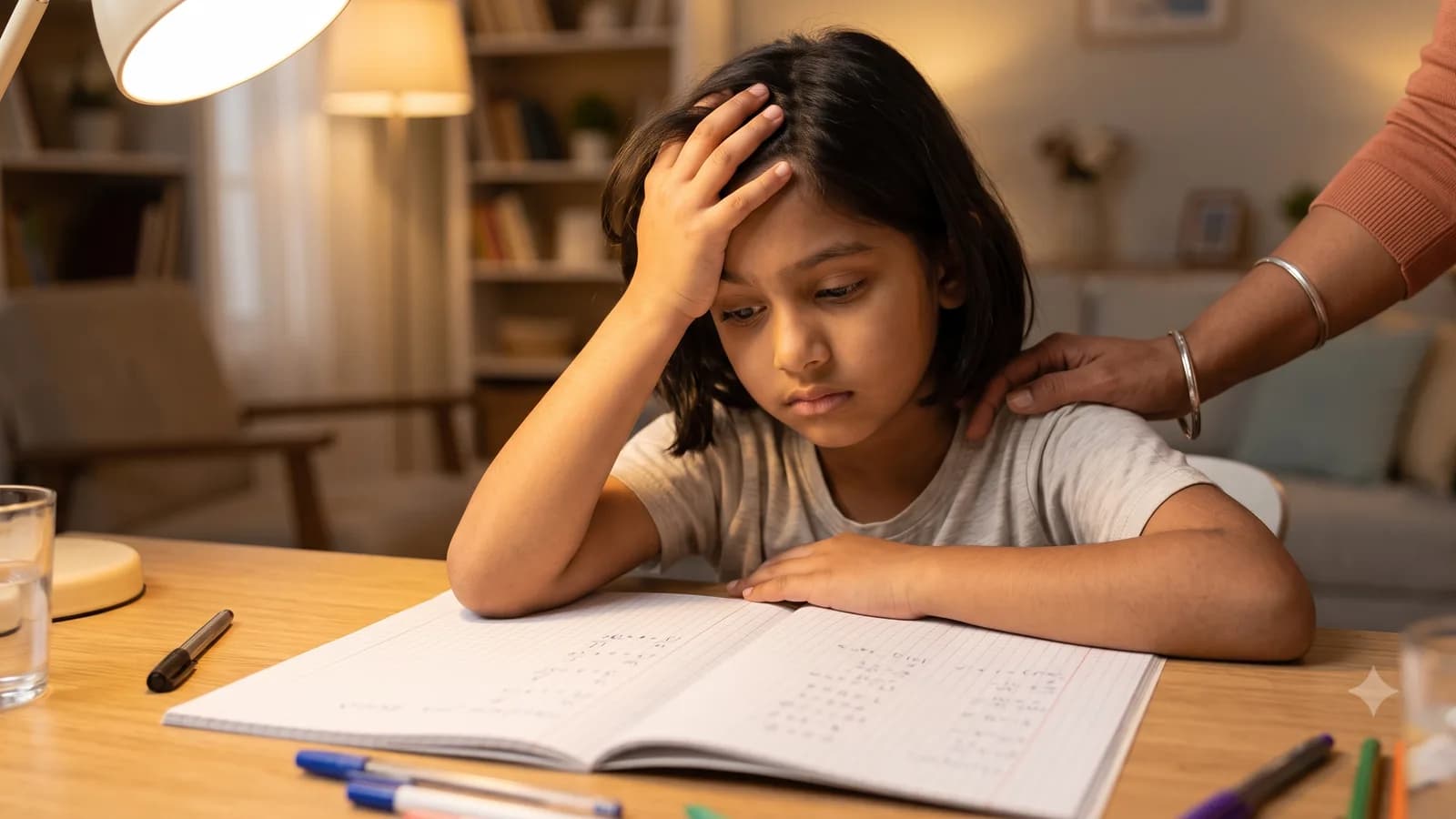
This produces a loop that is miserable and self-confirming. Fear reduces performance. Reduced performance confirms the fear. Confirmed fear increases avoidance. Avoidance reduces practice, which genuinely reduces ability -- and at that point the belief has become true, having started out false.
The important consequence: telling an anxious child to do more practice questions often fails, not because practice is wrong but because the fear is the bottleneck and practice does not touch it.
The American Psychological Association's guidance on helping children manage maths anxiety is a reasonable starting point if you want a clinical framing. Nothing in this article is a substitute for talking to a professional if a child's distress is severe or spreading beyond schoolwork.
The finding that surprises parents
This is the part worth knowing even if you read nothing else.
Researchers at the University of Chicago examined whether parents' own anxiety about mathematics affected their children's learning. The headline result is that children of maths-anxious parents learned less maths over a school year than children of parents who were comfortable with the subject.
That alone would be an unhelpful finding -- you cannot easily change how you feel about long division. But there was a qualifier, and the qualifier is the actionable part.
The effect appeared mainly among children whose anxious parents helped frequently with maths homework. Where anxious parents were not regularly involved in homework, their children's learning was not affected in the same way.
Read that carefully, because it is easy to take the wrong message from it. It does not say that anxious parents harm their children. It says that anxiety appears to transmit through the interaction -- through tone, through visible frustration, through the sighs and the "I was never any good at this either" -- rather than through genes or through the mere fact of being in the house.
A follow-up line of work points the same direction from the other side: when the interaction is structured differently, children of anxious parents can do well. The route of transmission is the thing that can be changed.
The practical implication is not "stop helping". It is that how you help matters more than how much, and that for some parents the most useful contribution is warmth and logistics rather than instruction.
Phrases that cost more than they seem to
None of these are unkind. Most are said to comfort. All of them carry an unintended message.
"I was terrible at maths too." Intended as solidarity. Received as permission -- this is hereditary, it is settled, there is no point struggling.
"Don't worry, you won't need it." Intended as perspective. Received as confirmation that the child is right to give up on it.
"It's easy, just..." Intended as encouragement. Received as evidence that a thing which is easy for everyone else is impossible for them.
"Why can't you see it? We just did this." Said in genuine frustration at eight in the evening. Received as the whole verdict.
"You're just not a maths person." The most damaging, because it converts a temporary state into an identity, and identities are not revised by a good test result.
What these share is that they all frame difficulty as a fixed property of the child rather than a feature of the material. Maths is hard for almost everyone at the point where they are learning it. Difficulty is the normal experience of the subject, not a sign that something has gone wrong.
What to do instead
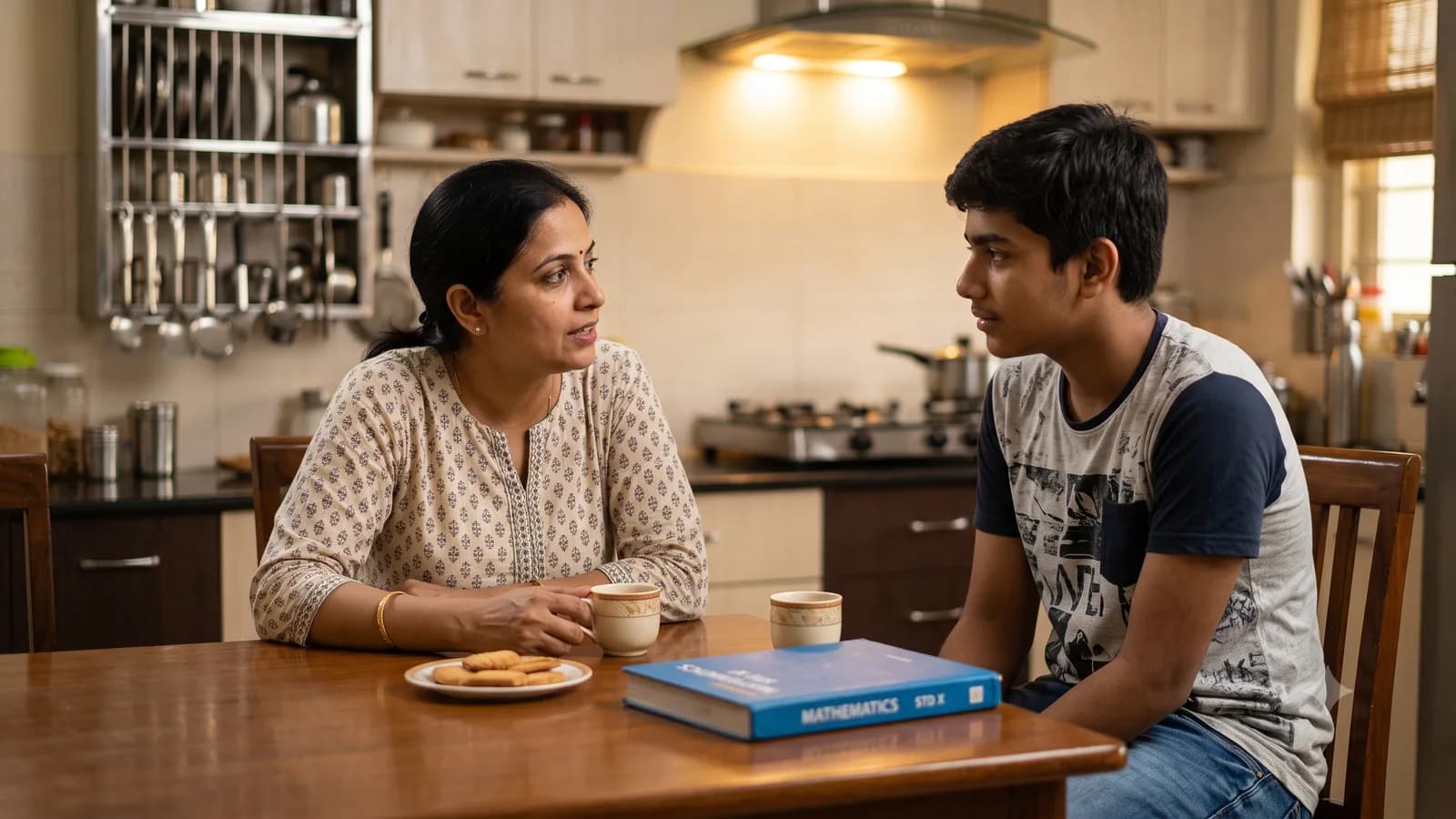
Separate the homework help from the emotional support, and take the second job. If maths sets your teeth on edge, you are allowed to say so honestly -- to another adult, not to the child -- and hand the explaining to a teacher, a tutor, a video, or an older sibling. Sitting beside them, staying calm, and keeping the tea coming is a real contribution and, on the evidence above, possibly a better one.
Name the difficulty rather than the child. "This topic is hard" instead of "you're finding this hard". It sounds like a small distinction. It locates the problem somewhere it can be solved.
Let the struggle run longer than is comfortable. The strongest urge of an anxious parent watching a child stall is to step in. Stepping in ends the discomfort for both of you and removes the part of the process where learning happens. Wait. Count to sixty in your head if you need to.
Praise the method, not the speed. Speed is the dimension on which maths anxiety is most acute, and it is the least important one at school. "You kept going when it got messy" is worth more than "quick".
Talk about maths outside homework. Splitting a bill, doubling a recipe, working out whether the larger packet is better value. This does two things: it demonstrates that the subject exists outside the anxiety-inducing context, and it lets the child be competent at it when nothing is at stake.
Watch your own commentary in front of them. The dinner-party joke, the eye-roll at the electricity bill, the "I'll let your father do that one". Children are extremely good at inferring what the adults around them believe, and considerably less good at knowing when a joke is a joke.
If the anxiety is specifically about tests
Test anxiety and maths anxiety overlap but are not identical, and the fix differs. A child who is calm doing problems at the kitchen table and freezes in an exam is dealing with the conditions rather than the content.
The most effective intervention here is boringly mechanical: practise under the actual conditions. Closed book, timed, no help available, a question set they have not pre-sorted by topic. The fear of an exam is substantially a fear of an unfamiliar situation, and the situation stops being unfamiliar if you rehearse it.
This is also the diagnostic that distinguishes the two problems. A child whose performance collapses only under exam conditions has an exam problem. A child who cannot start a problem at the kitchen table on a Saturday has a maths problem. They need different responses, and the way maths itself has to be studied addresses the second one directly.
When to get outside help
Reasonable triggers:
- Physical symptoms. Stomach aches on maths days, tears before the lesson, genuine dread. This is beyond a study-technique issue.
- Refusal. A child who will not attempt the work at all is telling you the fear has won, and pushing harder from inside the family generally escalates rather than resolves it.
- It has stopped being about maths. If the anxiety has spread to school generally, to sleep, or to how the child describes themselves, that is worth raising with a doctor or the school's support staff rather than a tutor.
- The homework hour is damaging the relationship. This is a legitimate reason on its own. Some things are not worth the cost of doing yourself.
A tutor helps here for a reason that has little to do with subject expertise: they are not you. The stakes are lower with a stranger, a wrong answer carries no family history, and the child can be a beginner without that meaning anything about who they are. If you are weighing up whether it has reached that point, the broader signs that a child needs a tutor apply, with emotional charge counting for more than the marks do.
One distinction worth drawing before you act, because the two are often confused: a child who is frightened of maths and a child who has stopped caring about school look similar from the outside and need almost opposite responses. Disengagement has its own causes, and treating fear as laziness is the most common way parents make an anxious child worse.
Finally, a practical note on homework itself. The evening maths session is where most of this plays out, and it is also where a lot of families now have a chatbot sitting open on the table as a peacekeeper. It does end the argument. Whether it ends the learning is a separate question worth being deliberate about, particularly for a child who already believes they cannot do it -- an answer that appears without them is one more piece of evidence for that belief.
If maths has become a source of conflict at home, handing it to someone outside the family is often the fastest way to lower the temperature.
- Book a free demo class -- tell us the subject has become stressful; it changes how we approach the first session
- See our maths courses