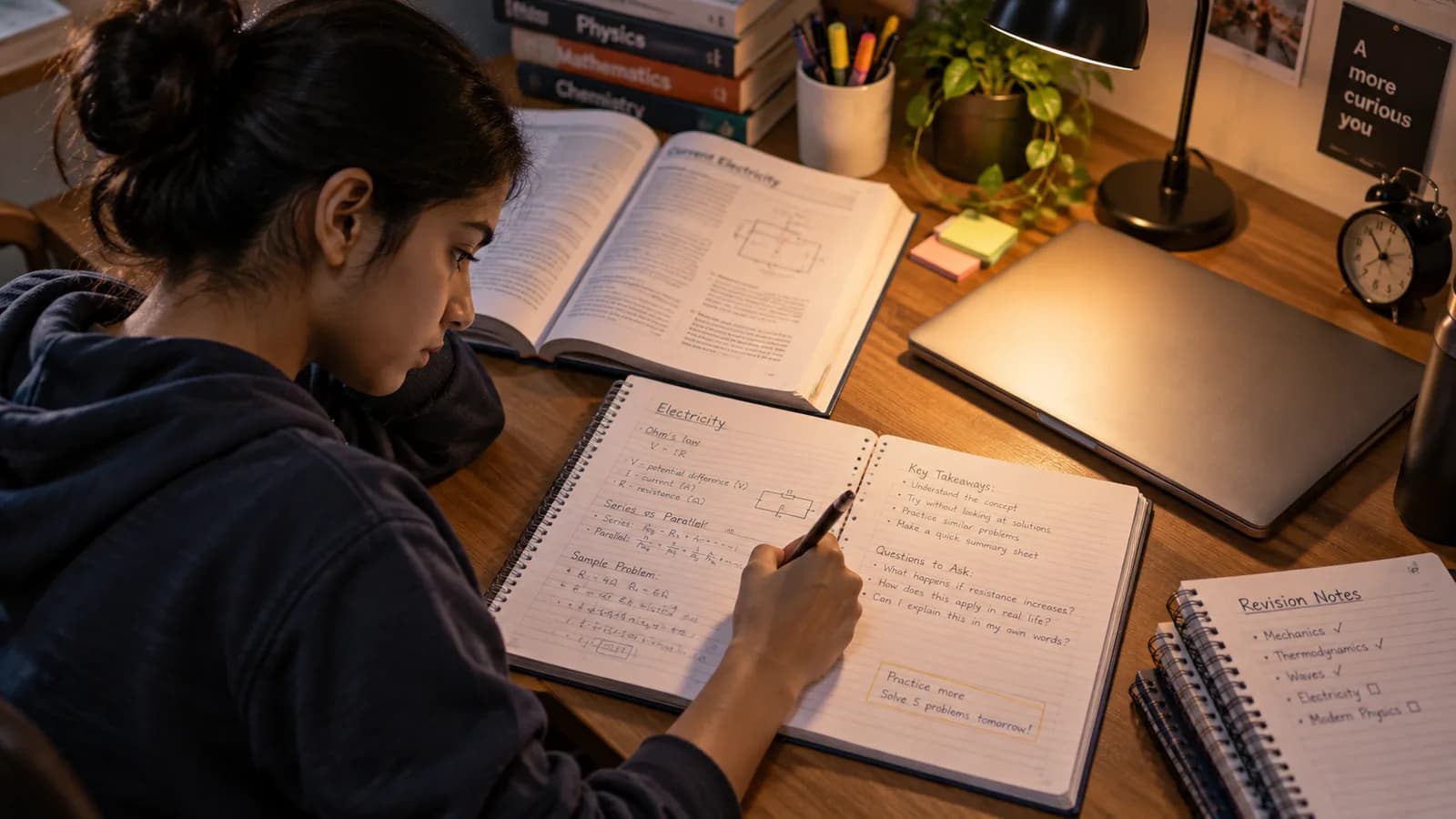
This one is written for students rather than about them. No lecture about cheating, no suggestion that you stop. You are going to use AI to study, so the only question worth answering is how to do it in a way that does not quietly make you worse at the subject.
The study you should know about
Researchers gave roughly a thousand high school students access to GPT-4 while they worked through maths practice. The results were published in PNAS.
While the tool was available, performance on practice problems jumped. Substantially.
Then it was taken away for the real exam. The group that had used the unrestricted version scored about 17% worse than students who had never had access at all. Not worse than they had been with it. Worse than if they had never used it.
Read that twice, because it is the thing nobody tells you. It is possible to spend a month practising, feel like it is going well, and end up behind where you started.
Why it feels like learning when it is not
Learning something and being able to do something right now are different, and your brain is bad at telling them apart.
When an explanation is in front of you and it makes sense, you get a strong feeling of understanding. That feeling is generated by following reasoning, which is much easier than producing it. Retrieval, the effortful business of dragging something out of your own head, is what actually builds durable memory, and it is precisely the step an AI answer removes.
So the rule underneath everything below: if the AI did the hard part, you did not.
Six methods that survive the tool being taken away
1. Attempt first, always
Write your own answer before you ask anything. Even a wrong one, even a partial one. Then ask the AI to find the error in your reasoning rather than to solve the problem. You keep the retrieval; you get the feedback.
2. Ask for the next question, not the answer
"Give me three more problems like this one, slightly harder, and do not show me the solutions" is one of the most valuable prompts available to you, and almost nobody uses it. Unlimited targeted practice is genuinely what this technology is best at.
3. Make it interrogate you
Ask it to quiz you on a chapter, one question at a time, without telling you the answers until you have committed. Then ask it to explain only the ones you got wrong. This flips the initiative from you to the tool, which is roughly what separates a study assistant from a real tutor.
4. Explain it back, and let it mark the explanation
Teach the concept to the AI in your own words and ask it to identify what you have missed or stated imprecisely. If you cannot produce the explanation, you do not know the thing, and you have found that out in thirty seconds.
5. Use it to find gaps, not to fill them
"Here are my five wrong answers. What is the single underlying misunderstanding?" is a question a tool can answer well and that you would struggle to answer yourself. What you do about that gap should still be practice, not reading.
6. Run the closed-book check
Before you move on, redo one problem from today with everything closed. Tomorrow, redo it again. If you cannot, the session did not work regardless of how it felt. This is the only honest test, and it is the one the PNAS students never ran.
Answer-first and question-first prompting
Most of what goes wrong is settled by the shape of your first message.
Answer-first (avoid): "Solve this quadratic for me." / "Write an introduction for my essay on the water cycle." / "What is the answer to question 7?"
Question-first (use): "Here is my working for this quadratic. Where did it go wrong?" / "Here is my introduction. What is the weakest sentence and why?" / "I got question 7 wrong twice. Ask me something simpler that tests the same idea."
Same tool, opposite outcome.
Is this cheating?
Depends entirely on what you are asking for, and your school has the final say. But there is a reasonable line: using AI to check your thinking is studying; using AI to replace your thinking is not.
Students broadly agree, which is more interesting than it sounds. Pew Research Center found that US teens considered ChatGPT acceptable for research (54%) far more than for solving maths problems (29%) or writing essays (18%). The instinct is already there.
If the specific question is homework, there is more detail in Can AI help with homework?.
The rule of thumb
At the end of a study session, ask yourself one thing:
Could I do this again tomorrow, with nothing open?
If yes, the session worked. If no, you had a pleasant time watching someone else do maths. Everything above is just different ways of making the answer yes more often.
One last thing
Feeling fluent is not evidence. The students in that study felt fine. The only evidence is what you can do when the help is gone, which, in an exam hall, it will be.
Everything above assumes you already know how to revise unaided. If you are not sure you do, the method underneath all of it is closing the book and testing yourself, and it works without any tool at all.
How eGunas helps your child
eGunas teaches one child at a time. A session follows the student's own board syllabus but is built around what that particular student needs next -- their pace, the topics they are actually weak at -- rather than one lesson delivered to thirty students at once. That is what personalised learning means in practice.
eGunas AI, our AI-powered learning platform, is planned for 2026 and not available yet. It is being designed to extend that same individual attention beyond the lesson hour: practice pitched at the right difficulty, available whenever your child sits down to work, so progress can continue between sessions instead of waiting for the next one.
- Browse our courses -- CBSE, ICSE and state boards, Classes 1 to 10
- How eGunas online tutoring works -- one-to-one lessons online, wherever in India you live
- Book a free demo class -- one-to-one with a tutor, at no cost
- Ask us about your child -- tell us the subject and year, and we will say honestly whether we can help
New articles are published on the eGunas blog.