Ask a room of students how they revise and most will describe some version of the same thing: read the notes, highlight the important parts, read them again closer to the exam. It is the method almost everybody converges on without being taught it, and it is one of the least effective options available.
The alternative is not more hours. It is a different action: shut the book and try to produce the material from memory before you have any right to. That is retrieval practice, and it has as much supporting evidence behind it as anything in education research.
Why rereading feels like it works
Because it feels easy, and we mistake ease for knowledge.
The second time you read a page, it goes down smoothly. Nothing surprises you. Every sentence arrives already familiar. Your brain interprets that smoothness as I know this -- and it is a reasonable interpretation, except that it is measuring the wrong thing. What you are detecting is recognition: the ability to identify material when it is placed in front of you.
An exam does not place the material in front of you. It asks you to generate it from nothing. Recognition and generation are different capacities, and practising one does not reliably build the other.
This is why the experience of revision is such a poor guide to its value. The methods that feel most productive -- rereading, highlighting, copying out notes neatly -- are mostly the ones that keep you in recognition. The methods that feel worst are mostly the ones that make you generate.
A 2013 review in Psychological Science in the Public Interest by Dunlosky and colleagues assessed ten common study techniques against the experimental evidence. Practice testing came out in the top group for usefulness. Highlighting and rereading came out in the lowest, despite being the two most widely used.
What retrieval practice actually is
It is one move: try to recall something before you look at it.
That is the whole technique. Everything else is packaging. It does not require flashcards, an app, a particular notebook, or a system with a name. It requires only that the moment of recall happens before the moment of checking, and that the recall is genuinely attempted rather than skipped.
The canonical demonstration is straightforward. Give people material to learn. Have one group restudy it and another group test themselves on it, spending the same total time. Then test everybody after a delay. The restudy group usually feels more confident. The testing group usually remembers substantially more -- and the gap tends to widen the longer you wait before the final test, which is exactly the wrong direction for anyone planning to sit an exam in three weeks. Roediger and Karpicke's experiments in Psychological Science in 2006 are the standard reference for this pattern.
There is a second effect that matters just as much for a student. When you attempt recall and fail, you find out immediately and specifically what you do not know. Rereading gives you no such signal, which is why students who revise by rereading are so frequently confident going into an exam they are about to do badly in. Retrieval practice is an unusually honest method, and its honesty is most of its value.
Doing it without flashcards
Flashcards are fine. They are also the reason many students conclude retrieval practice is not for them, because building a deck is tedious and only really suits material that splits into short question-and-answer pairs.
Four methods that need no preparation at all:
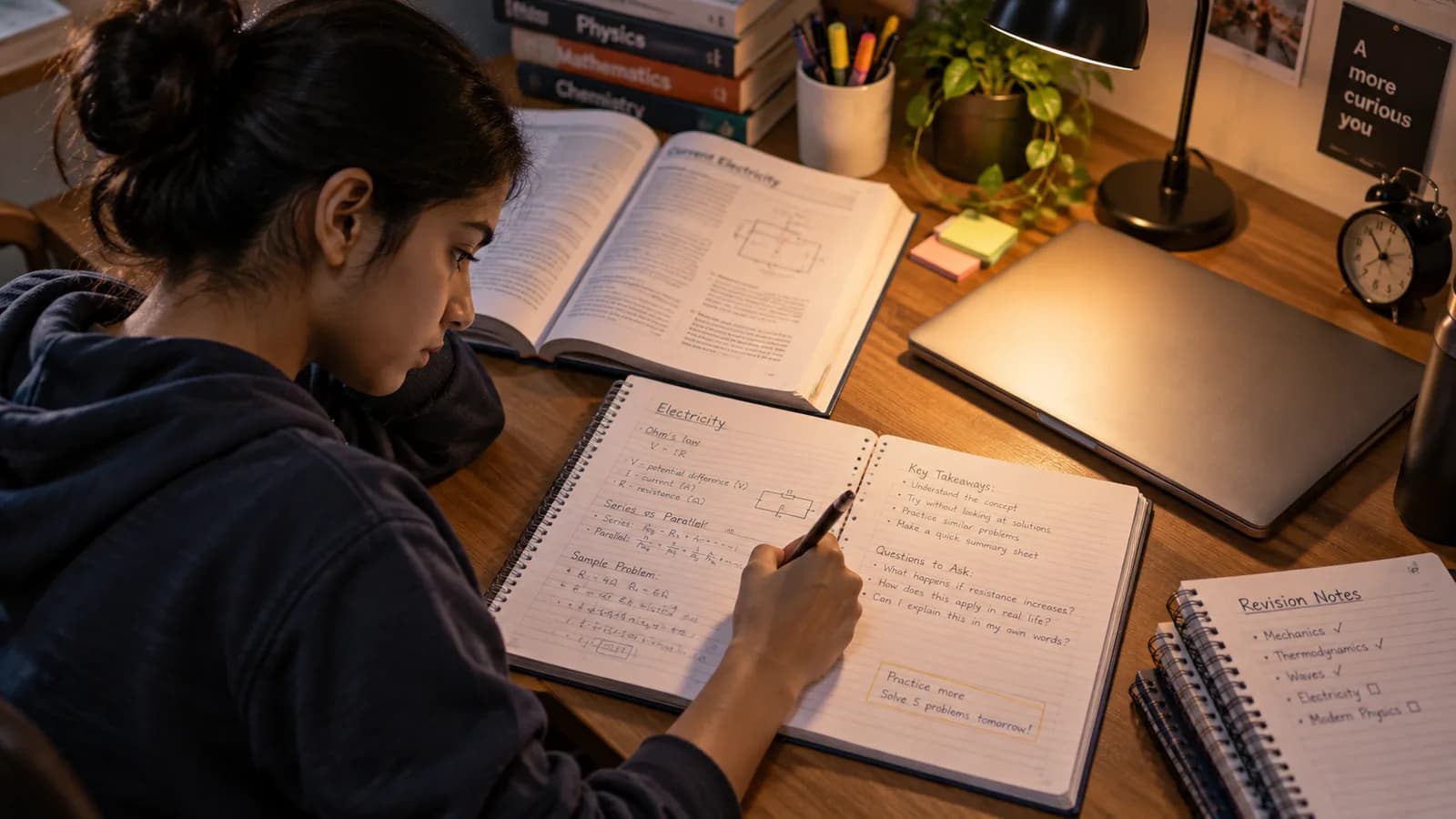
The blank page. Close everything. Write down everything you can remember about the topic. Then open the book and mark what you missed in a different colour. The missing parts are your revision list -- you now have one, and it took eleven minutes to produce.
Turn the headings into questions. Read only the subheadings in the chapter. For each one, say the answer out loud before reading the section. You have converted a passive text into a test without writing anything.
Explain it to someone who is not there. Out loud, no notes, as though teaching it. The point is that speech forces continuity: you cannot skip the part you do not understand, because the sentence has to finish. The gaps become audible.
The end-of-day recall. Three minutes before bed, list what today's lessons covered without opening anything. This is the cheapest habit on the list and it doubles as a way to find out what you missed while your attention wandered.
Note what all four have in common. None of them involve looking at the material while you work. The instant the book is open, you are back in recognition.
The three mistakes that kill it
Students who adopt this and report that it did not work are usually making one of these.
1. Checking too early
You attempt recall, hesitate for two seconds, and glance at the page. Nothing has happened. The productive part of retrieval is the effortful search -- the ten or fifteen seconds of genuine trying -- and cutting it short removes the entire mechanism.
The rule: sit with it until you either produce the answer or are certain you cannot. Difficulty here is not a sign that the method is failing. It is the method.
2. Testing only what you already know
There is a strong pull toward the cards you get right, the topics you like, the chapter you understand. It feels productive because your success rate is high. It is the revision equivalent of practising the shots you can already make.
The rule: sort by difficulty, not by preference. The material you most want to skip is the material the exam will find.
3. Doing it all at once
Retrieval practice on Tuesday, again on Tuesday, and again on Tuesday is far weaker than the same three attempts spread across a fortnight. Spacing the attempts is not an optional refinement -- the two effects compound, and most of the long-term benefit comes from the combination.
The rule: a topic should come back after a day, then after a few days, then after a week or two. Not perfectly. Just not all at once.
A fourth, smaller mistake: doing this only in the last week. Retrieval practice used as a revision method a fortnight before an exam is useful. Used as the way you learn all term, it is transformative, because each recall attempt is also a spaced repetition of everything before it.
Content subjects and procedural subjects need different versions
The method changes shape depending on what you are studying, and this trips people up.
For content-heavy subjects -- biology, history, geography, vocabulary, definitions -- retrieval in its plain form is exactly right. Blank page, closed book, produce the material.
For procedural subjects -- maths, physics, chemistry calculations -- what you retrieve is not a fact but a method, and the only honest test is doing a problem you have not seen, closed-book, from a mixed set. Reciting the formula proves very little; the skill is recognising which situation calls for it and executing without slips. That is a large enough difference that we have written about why maths has to be studied differently separately.
The practical translation for procedural subjects: your flashcard is a problem, your recall attempt is a full solution on paper, and your check is the mark scheme.
How often, concretely
A schedule that works for most students, without needing an app:
- Same day: three minutes of end-of-day recall on whatever was covered.
- Two to three days later: one blank-page attempt on the topic. Ten minutes.
- A week later: a handful of the questions you got wrong, repeated cold.
- Two to three weeks later: one mixed set that includes this topic among others, so you have to identify it rather than being told.
That is roughly twenty-five minutes per topic spread over three weeks, and it will hold better than several hours of rereading the night before. The last step is the one that most closely resembles the actual exam, and it is the one most revision plans leave out.
When this is not the problem
Retrieval practice is a method for consolidating material you have understood. It is not a method for understanding material you never did.
If a student attempts the blank page and produces nothing at all -- not partial recall, but genuine blankness, repeatedly -- the issue is usually upstream. Something earlier in the sequence was never learned, and no amount of self-testing on chapter seven will supply chapter four. Finding where the break actually is has to come first.
And one physical caveat that is easy to dismiss and quite hard to work around: consolidation happens largely during sleep. A student running on five hours is losing a meaningful share of the benefit of everything described here, which is why sleep is not the thing to cut when the exam is close.
The short version
Stop reading your notes. Close them and try to write down what was in them. Do it a few days apart rather than all at once. Go toward the material you cannot recall rather than away from it.
It takes less time than what you are doing now, and it will feel considerably worse. That feeling is the difference between recognising something and knowing it, and it is better to meet it at your desk than in an exam hall.
Retrieval practice is free and you can start tonight. If the gap turns out to be understanding rather than method, that is a different problem and we can help with it.
- Book a free demo class -- bring the topic that keeps not sticking
- See what we teach