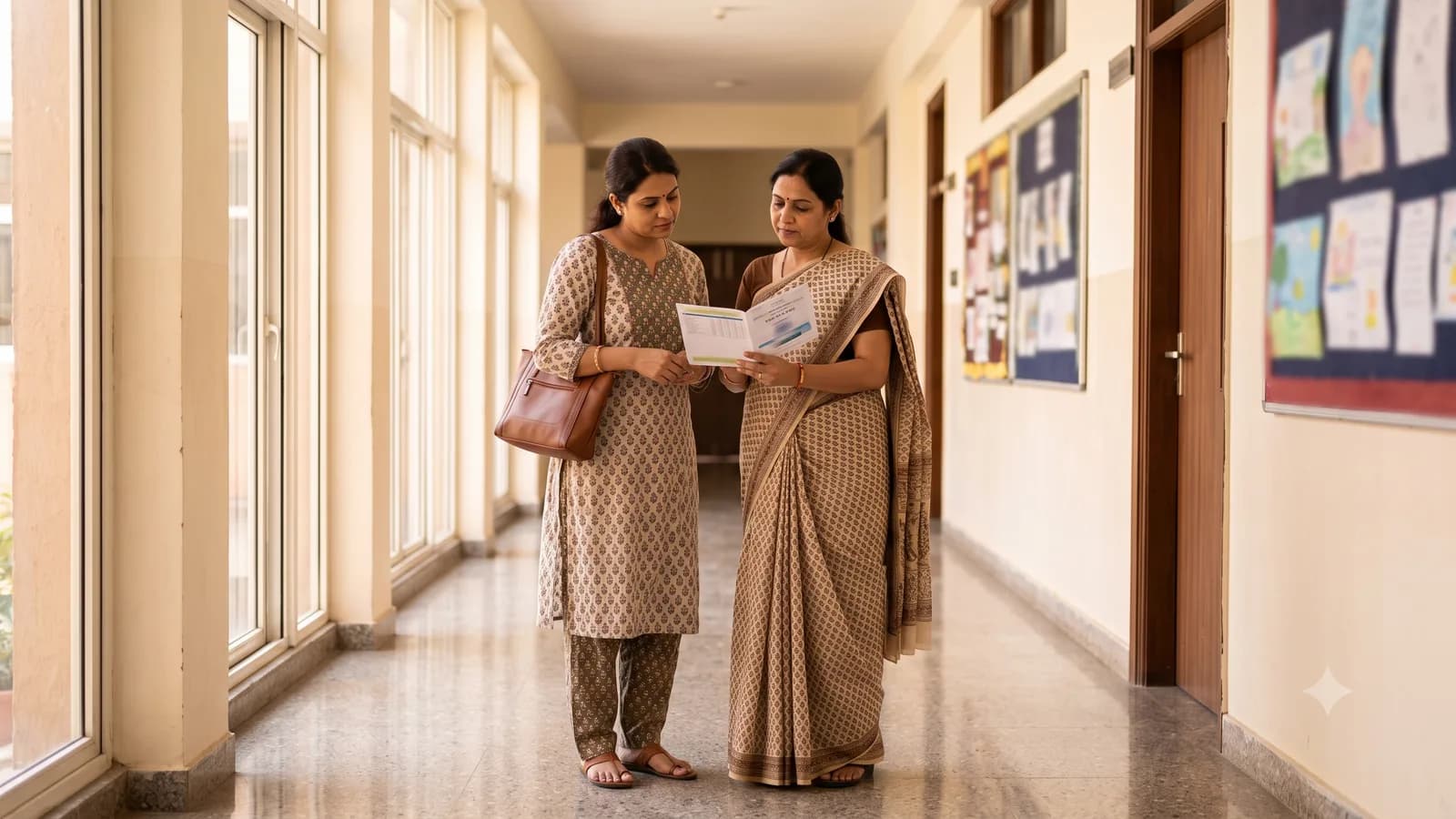
Parents rarely arrive at this question calmly. It usually follows a report card, a parents' evening, or a Sunday night that ended in tears over a worksheet. In that state it is easy to do one of two things: panic and hire someone immediately, or wait another term and hope.
Both are guesses. This article is an attempt to make it less of a guess: what actually predicts that a tutor will help, what looks alarming but generally resolves on its own, and what is worth trying first because it costs nothing.
Struggling and coasting are different problems
Before the signs, one distinction that decides most of this.
A struggling child is working and not getting there. Effort goes in, results do not come out. They sit down, they try, and something between the trying and the understanding is not connecting.
A coasting child is getting there without working. Marks are fine, homework is done in fifteen minutes, and nothing is being asked of them that requires effort.
Tutoring answers the first problem well. It answers the second one badly, because the second problem is not a knowledge gap -- it is a challenge gap, and adding an extra hour of the same level of work makes it worse rather than better. A coasting child needs harder material, a competition, an older sibling's textbook, or a subject they cannot already do. Not more of what they already find easy.
There is a third case, and it is the most common one in our experience: a child who used to be fine and is now not. That is the case where the seven signs below matter most, because something specific has usually broken and it can usually be found.
Seven signs worth acting on
1. They can do the homework but not the test
This is the single most diagnostic sign, and most parents read it backwards. Homework is done with the book open, the example on the page above, and no time limit. A test is none of those things. A child who scores well on one and badly on the other has not learned the material -- they have learned to follow a model that was in front of them.
That gap is precisely what a tutor is for, because closing it requires someone to sit there while the child works without the model, which is not something a worksheet can enforce.
2. The gap is in one subject, not all of them
A child who is at sea in every subject usually has something else going on: a reading difficulty, an attention difficulty, something happening at home or at school, or exhaustion. Tutoring the maths will not fix any of those, and you will have spent money on the wrong problem.
A child who is fine in four subjects and lost in one has a subject-specific gap. That is tractable, and it is what a tutor is actually good at.
3. They have stopped asking questions in class
Children ask fewer questions as they fall further behind, not more. Once a lesson has passed the point where they can follow it, they cannot form a question about it -- they do not know enough to know what to ask. Silence in class from a child who used to participate is often the point where the gap became too wide to bridge in real time.
A teacher with thirty students cannot detect this reliably. A parent often can, if they ask the right question: not "did you understand today?" but "what did you ask about today?"
4. Homework takes dramatically longer than it should
Not slightly longer. Dramatically. If a task designed for twenty minutes is taking ninety, the child is not doing that task -- they are rebuilding the prerequisite knowledge from scratch every time, badly and alone, before they can start it.
This is expensive in a way that is easy to miss. It eats the evening, it destroys the child's relationship with the subject, and it usually still produces the wrong answer.
5. They can't explain their own correct answers
Ask a child to talk you through a question they got right. If they can only point at the answer, or say "you just do it this way", they have a procedure and not an understanding. Procedures survive until the question is phrased differently, which is exactly what exams do.
This one is worth checking even when marks look fine, because it is the failure mode that appears with no warning a year later.
6. The subject has become emotional
Crying, anger, avoidance, sudden headaches on the day of the lesson. When a subject has acquired an emotional charge, the child is no longer able to learn it in the ordinary way, because the fear consumes the working memory the problem needs.
This is particularly well documented in mathematics, where the effect is strong enough to have its own research literature -- and where, uncomfortably, a parent's own anxiety about the subject can transmit to the child. If the subject has become emotional, a neutral third party in the room is often worth more than any amount of additional explanation from you.
7. School has told you, more than once
Teachers are, if anything, reluctant to recommend paid help. When a teacher raises the same concern twice, unprompted, that is a professional judgement formed over months of watching your child work alongside thirty others. It is the best free information you will get, and it is worth more than a single bad report.
Three signs that usually aren't
One bad report card
A single poor term is weak evidence. Illness, a teacher change, a topic that happened to be badly timed, a friendship problem, a growth spurt that wrecked their sleep -- all produce one bad term and resolve without intervention.
What matters is the trend. Two consecutive terms in the same direction in the same subject is a signal. One is noise.
Slower than a sibling or a classmate
Comparison is the least reliable input available to a parent, and the most emotionally loaded. Children in the same class can be a year apart developmentally and both be entirely typical. A child who is slower than their older sibling was at the same age is, in most cases, simply a different child.
The question is not "are they behind someone" but "are they behind where they were, or where the syllabus needs them to be".
Disliking a subject
Disliking a subject is normal and mostly survivable. Every adult reading this disliked something at school and went on to be fine. Dislike only becomes a problem when it is downstream of not understanding -- which is a different thing, and shows up as the signs above, not as an opinion.
A child who says "I hate history" and gets 70% does not need a tutor. A child who says "I hate history" and cannot tell you what last week's lesson was about might.
What to try before you pay for anything
Four things, in order, none of which cost money.
Ask the teacher one specific question. Not "how is she doing", which produces a reassuring non-answer. Ask: what is the one thing she most needs to fix, and where did it start? Teachers usually know, and are rarely asked directly.
Run a closed-book check. Take something your child did last week, close everything, and ask them to do it again. Two minutes. If they can, the material is in. If they cannot, it never was -- and now you know what you are dealing with.
Trace the gap backwards. Most "I don't understand chapter seven" problems are really "I never understood chapter four" problems. Working backwards until you find the last thing they can do confidently is often the entire diagnosis, and we have written about how to find and close that kind of gap in detail.
Change how they revise, before changing who teaches them. A large fraction of what looks like a comprehension problem is a revision-method problem -- specifically, rereading notes and mistaking familiarity for knowledge. Testing yourself properly is free, takes a week to adopt, and sometimes removes the need for anything else.
If all four have been tried and the picture has not changed, you have real evidence rather than a worry, and the decision becomes much easier.
What a tutor can't fix
Worth being honest about, because a lot of money is spent discovering it the slow way.
A tutor cannot fix a motivation problem. If a child has decided the subject does not matter, an extra adult explaining it more clearly changes very little -- the explanation was never the obstacle. That is a different problem with a different approach.
A tutor cannot fix an undiagnosed learning difference. Tutoring can support one, and assistive technology can help considerably, but neither substitutes for an assessment. If a child struggles with reading itself rather than with the subject being read about, that is the thing to investigate first.
A tutor cannot fix a sleep problem. A consistently under-slept teenager is not learning efficiently in any setting, tutored or not -- and the research on what sleep does to what you studied is unusually clear about why.
A tutor cannot fix an organisational collapse. Missing books, lost homework, no idea when the test is. That is a systems problem, and it will follow the child into the tutoring session.
If you decide to start
Three practical things.
Define what "working" looks like before you begin. Not "better marks" -- that is too slow and too noisy to act on. Something observable within a month: can redo last week's work unaided, can explain a method out loud, stops avoiding the homework. If you do not set this in advance, you will find yourself paying for a year on the basis of a feeling.
Start with a diagnosis, not a syllabus. A good first session finds out where the break is. A session that begins by teaching the current chapter has assumed the answer to the question you are paying to have answered.
Decide the format deliberately. One-to-one, small group, online, in person -- these are not interchangeable, and the right answer depends on the child rather than on the price. We have compared the trade-offs in how to choose a tutor, and there is a separate question most providers avoid: how much tutoring a child actually needs, which is usually less than you would be sold.
The American Psychological Association's summary of the homework research makes a point worth ending on: more time on academic work is not reliably better, and beyond a certain point the returns flatten or reverse. The aim is not to add hours. It is to find the specific thing that is broken and fix that.
Wondering whether your child is in the first list or the second? eGunas runs one-to-one lessons for CBSE, ICSE and state boards, and the first one is free precisely so you can find out before committing.
- Book a free demo class -- a tutor will tell you honestly what they see
- Browse subjects and classes
- See how one-to-one online tutoring with eGunas works