You have read the slogan: AI will not replace teachers, but teachers who use AI will replace those who do not. It is a neat sentence that answers nothing, and it has been repeated so often that it now functions as a way of avoiding the question.
Here is an attempt at a real answer. It requires giving up the idea that "teaching" is one thing.
The question is wrong, and here is the better one
"Can AI replace teachers?" treats the job as a single unit. It is not. A teacher does at least nine distinguishable things in a week, and they are not equally exposed to automation. Some are largely solved. Some are nowhere close.
The better question is: which tasks, and what is left?
Teaching, broken into nine tasks
- Explaining a concept clearly
- Generating practice at the right difficulty
- Marking routine work
- Diagnosing why a student is wrong
- Deciding what this student should do next
- Motivating a student who has disengaged
- Managing a room of thirty adolescents
- Noticing that something is wrong outside the subject
- Being accountable to families and the institution
Four it already does as well or better
Explaining a concept (task 1). With infinite patience and in as many different ways as asked. In the randomised trial published in Scientific Reports, a purpose-built AI tutor beat an active-learning physics classroom on both learning and time taken, with 194 undergraduates. Explanation is not the strong ground for a human argument.
Generating practice (task 2). Unlimited, targeted, instantly. No teacher can produce twenty fresh questions at exactly the right difficulty during a lesson.
Marking routine work (task 3). For anything with a determinate answer, this is solved, and it is a large fraction of the hours teachers actually spend.
Deciding the next step within a topic (task 5, partially). Within a well-mapped subject, a system with a model of the student can sequence as well as a person, and more consistently.
That is four of nine, and they include some of the most time-consuming. Anyone claiming AI cannot teach is not looking at the evidence.
Five it does badly, and why
Diagnosing the unusual (task 4). Systems are strong on common misconceptions, because those are well represented in the data. The self-invented misunderstanding is the case with the least to pattern-match against, and it is the one where a person asking "show me how you got that" still wins.
Motivation (task 6). Nothing in the evidence supports AI here. The Harvard trial's participants were undergraduates who had enrolled in the course. It measured learning among the already-motivated, which is the easy half of the problem.
Managing a room (task 7). Not a subject-matter task at all. It is social, physical and improvisational.
Noticing what is not said (task 8). A child who is quieter than usual, or whose work has changed for reasons unrelated to the subject. This is the part of teaching that is not about teaching, and it is frequently the part that matters most.
Accountability (task 9). You can hold a person responsible. There is no meaningful sense in which you can hold a model responsible, and diffusing responsibility into a system is a choice with consequences.
What the Harvard trial did not test
Worth being precise, because this study is cited loosely in both directions.
It did not test: younger students, disengaged students, subjects with less structure than physics, long-term retention over months, or any classroom-management dimension. It tested learning of specific physics content by consenting university students over a short period.
That is a genuine and important result. It is not evidence about schools.
The crutch finding cuts both ways
The other major 2025 study, in PNAS, found that about a thousand high school students given unrestricted GPT-4 during practice scored roughly 17% worse on the real exam than students who never had it.
For this question the implication is specific: the failure was not that AI taught badly. It is that a system optimised to help, without someone deciding what should be withheld, produced worse outcomes than nothing. That decision, about what to not give a student, is a teaching decision. It is currently made by a person, at design time or in the room.
What actually changes for teachers
Less speculation, more arithmetic. If tasks 1, 2, 3 and part of 5 are increasingly carried by software, then the hours move. Marking and generating materials shrink. What is left is the part that was always the hardest: diagnosis, motivation, judgement, and responsibility for a particular child.
That is not a smaller job. It is a more concentrated one, and arguably a harder one, since the routine work that filled the week also provided recovery time within it.
The Indian context
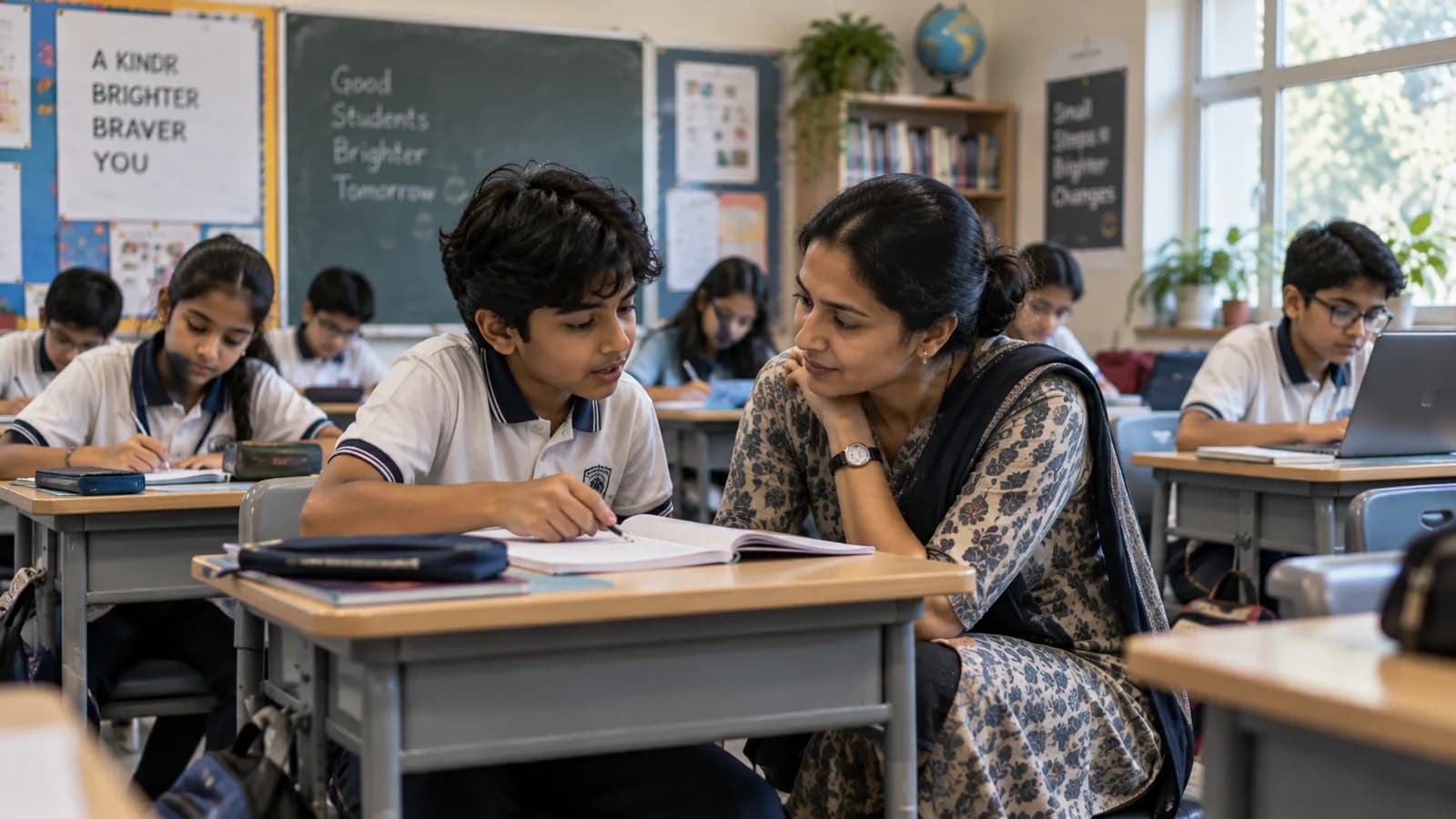
One thing that changes the calculation locally is class size. In a large class, the constraint on personalization is not the teacher's skill but the arithmetic of attention: one adult cannot diagnose thirty students in forty minutes.
This is the setting where AI has the clearest case, and it is not a replacement case. A system that handles explanation, practice and marking is a way of giving one teacher back the hours to do task 4 and task 6 with the students who need them. The bottleneck was never the teaching ability. It was the hours.
The answer
No, in any sense that matters. Yes, to a substantial and growing share of the tasks.
If your job is explaining and marking, that ground is shifting fast. If your job is working out why this particular child has stopped and what to do about it, nothing in the current evidence comes close.
The arrangement that follows from all of this is not AI instead of teachers but AI alongside them, and for families choosing tutoring specifically, that comparison is here.
For teachers looking for the part of this that is already useful rather than argued about, it is accessibility: text-to-speech, dictation and task breakdown open up work a student can already understand.
How eGunas helps your child
eGunas teaches one child at a time. A session follows the student's own board syllabus but is built around what that particular student needs next -- their pace, the topics they are actually weak at -- rather than one lesson delivered to thirty students at once. That is what personalised learning means in practice.
eGunas AI, our AI-powered learning platform, is planned for 2026 and not available yet. It is being designed to extend that same individual attention beyond the lesson hour: practice pitched at the right difficulty, available whenever your child sits down to work, so progress can continue between sessions instead of waiting for the next one.
- Browse our courses -- CBSE, ICSE and state boards, Classes 1 to 10
- How eGunas online tutoring works -- one-to-one lessons online, wherever in India you live
- Book a free demo class -- one-to-one with a tutor, at no cost
- Ask us about your child -- tell us the subject and year, and we will say honestly whether we can help
New articles are published on the eGunas blog.